


Walking into a gym can feel intimidating, especially when you believe everyone is watching, judging, or evaluating your performance. For many women, gym anxiety has less to do with physical ability and more to do with uncertainty. Not knowing how to use equipment, worrying about exercising incorrectly, or comparing yourself with experienced members can create unnecessary pressure. Building athletic confidence for women starts with recognizing that these feelings are common and manageable. Confidence does not require becoming the strongest person in the room. It comes from becoming comfortable with your own process, learning at your pace, and understanding that every experienced athlete was once a beginner. When exercise becomes a personal practice rather than a performance for others, the gym can gradually become a place of growth instead of stress.
Why Gym Anxiety Happens to So Many Women
Gym anxiety can develop from several different experiences. Some women may feel uncomfortable because they are unfamiliar with strength-training equipment, while others may have had negative experiences with body image or fitness comparisons. Social media can also create unrealistic expectations by presenting highly polished fitness routines and physiques as normal benchmarks.
Another common issue is the fear of making mistakes. Someone might worry about choosing the wrong weight, performing an exercise incorrectly, or looking inexperienced. However, learning involves mistakes. A person who confidently asks for guidance may actually make faster progress than someone who avoids unfamiliar exercises altogether.
Recognizing the source of anxiety makes it easier to address. Instead of thinking, “I am not confident enough for the gym,” try identifying the specific concern. Is it equipment? Crowds? Other people? Your appearance? Once the problem becomes specific, you can create a practical solution.
Start With Familiarity Instead of Perfection
One of the simplest ways to reduce gym anxiety is to make the environment familiar. You do not need to master every machine or understand every training style before beginning. Spend your first few sessions learning where things are located and becoming comfortable with the surroundings.
Consider starting with exercises you already understand. Bodyweight squats, walking, light resistance exercises, and basic mobility movements can provide a comfortable introduction. As familiarity grows, introduce one unfamiliar movement at a time.
A useful beginner strategy is:
- Choose three to five exercises before arriving.
- Write down the equipment you need.
- Start with manageable resistance.
- Focus on controlled movement rather than heavy weights.
- Leave complicated exercises for later sessions.
- Track what you learn after each workout.
This approach removes the pressure to improvise. A simple plan can make entering the gym feel much less overwhelming.
Create a Personal Definition of Athletic Confidence
Confidence should not be measured only by appearance, muscle size, lifting numbers, or athletic performance. Athletic confidence for women can mean feeling capable of learning a new movement, walking into a busy gym without hesitation, or completing a workout even when motivation is low.
A confident exerciser understands her current abilities while remaining open to improvement. She does not need to compare her first month of training with another person’s fifth year.
Try measuring progress through personal achievements such as:
- Using a new machine independently.
- Increasing repetitions with good technique.
- Completing a planned workout.
- Improving balance or mobility.
- Recovering properly after training.
- Feeling less nervous in crowded spaces.
- Staying consistent for several weeks.
These victories may seem small, but they create evidence that you are capable. Over time, repeated evidence becomes genuine confidence.
Use Preparation to Reduce Uncertainty
Preparation can make a significant difference when gym anxiety comes from not knowing what to expect. Rather than arriving without a plan, prepare your workout in advance.
A written routine gives you a clear sequence to follow. You can also save the names of exercises, note suggested repetitions, and identify alternative movements in case equipment is occupied.
It is equally useful to prepare mentally. Give yourself permission to have an imperfect workout. You may forget an exercise, need to lower the weight, or spend extra time adjusting equipment. None of these situations mean the session failed.
Thespoonathletic encourages a practical approach to training confidence: focus on what you can control. Your preparation, effort, technique, and consistency matter much more than whether another person notices you.
Choose Beginner-Friendly Training Goals
A goal such as “I want to look fit” can be vague and may encourage constant comparison. Specific goals are more useful because they give you something measurable to work toward.
For example, you could aim to perform ten controlled bodyweight squats, complete two strength sessions each week, walk for thirty minutes, or learn three resistance-training exercises.
Beginner goals should be challenging enough to create progress but realistic enough to maintain. If a target creates constant pressure, adjust it.
| Confidence Challenge | Practical Strategy | Progress Indicator |
|---|---|---|
| Fear of unfamiliar equipment | Learn one machine at a time | Can set it up independently |
| Feeling watched | Focus on your routine | Less attention to others |
| Comparing your body | Track personal improvements | More positive self-talk |
| Fear of lifting incorrectly | Start light and learn technique | Better movement control |
| Crowded gym anxiety | Visit during quieter periods | Increased comfort |
| Not knowing what to do | Prepare a simple workout | Fewer uncertain moments |
The goal is not to eliminate every uncomfortable feeling. It is to become increasingly capable of handling those feelings.
Stop Treating Other People as Your Competition
Comparison is one of the fastest ways to weaken confidence. You may see someone lifting heavier weights, running faster, or performing advanced movements and assume you should be at the same level.
But fitness progress is influenced by training history, experience, recovery, genetics, lifestyle, and countless other factors. Comparing yourself with someone else rarely provides useful information.
Instead, compare your current abilities with your previous ones. Ask questions such as:
- Can I move with better control?
- Do I understand more exercises than before?
- Am I recovering better?
- Am I more consistent?
- Do I feel stronger during everyday activities?
This mindset shifts attention from external validation to personal development. Thespoonathletic emphasizes that confidence grows when women recognize their own improvements rather than using another person’s performance as a measure of worth.
Wear Clothes That Help You Feel Comfortable
Workout clothing can influence how comfortable you feel, particularly if body-consciousness contributes to gym anxiety. The best choice is not necessarily the most fashionable outfit. It is clothing that allows you to move freely and feel secure.

Choose practical fabrics, supportive footwear, and clothing appropriate for the activity. If you constantly adjust your outfit during training, it can distract you from your workout.
Comfort can also come from familiarity. Wearing an outfit you have already trained in successfully can eliminate one more uncertainty before entering the gym.
Remember that exercise clothing is equipment, not a test of appearance. Your workout does not become more valuable because your outfit looks impressive.
Use Small Exposure Steps to Build Confidence
If walking into a crowded gym feels overwhelming, there is no reason to force yourself into the most uncomfortable situation immediately. Confidence can be built gradually through exposure.
Begin with manageable situations. You might visit during a quieter period, spend ten minutes walking around, or complete a short routine using familiar equipment. Once that feels easier, gradually increase the complexity or duration of your workouts.
This method works because repeated experiences can make an unfamiliar environment feel ordinary. Each successful visit provides another reminder that you can handle the situation.
The process might look like this:
- Visit the gym and become familiar with the layout.
- Complete a short workout using familiar movements.
- Add one new exercise.
- Train for a little longer.
- Visit at a moderately busy time.
- Gradually introduce more challenging exercises.
There is no required speed. Your confidence should develop at a pace that supports consistency.
Learn to Use the Gym Without Feeling Embarrassed
Many women hesitate to ask questions because they believe doing so will reveal a lack of knowledge. In reality, asking for help is an effective way to learn.
If you do not understand how to adjust a machine, ask gym staff for assistance. If you are unsure about an exercise, seek qualified instruction. Learning proper technique is more important than appearing experienced.
You can also practice equipment setup when the gym is less busy. Familiarity with seat adjustments, resistance settings, and basic controls can remove much of the uncertainty surrounding future sessions.
Thespoonathletic supports the idea that knowledge and confidence reinforce each other. The more you understand about training, the less intimidating the environment becomes.
Develop a Stronger Inner Conversation
The language you use with yourself can either increase anxiety or make challenges easier to manage. Statements such as “Everyone is judging me” or “I am terrible at this” turn uncertainty into a personal criticism.
Replace them with realistic statements:
- “I am learning.”
- “I can start with a lighter weight.”
- “I do not need to be perfect.”
- “Everyone has a different starting point.”
- “I can ask for help if I need it.”
- “One uncomfortable workout does not define me.”
Positive thinking does not mean pretending everything feels easy. It means responding to difficulty with patience rather than self-criticism.
Build Confidence Through Consistency
Confidence rarely appears after one successful workout. It develops through repeated action. Each time you enter the gym, complete your routine, learn something, and leave safely, you strengthen your belief that you belong there.
Consistency also makes exercise feel more predictable. A familiar warm-up, training schedule, and exercise selection can reduce decision fatigue.
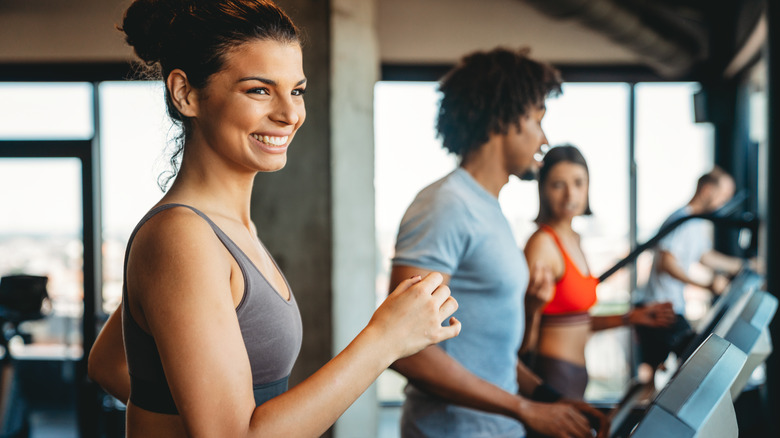
Instead of aiming for an extreme routine, choose a schedule you can realistically maintain. Two or three consistent sessions each week can be more valuable than an ambitious plan that becomes exhausting after a few days.
As your routine becomes normal, gym anxiety often loses some of its power.
Make Strength the Focus, Not Judgment
Strength training can be particularly useful for developing confidence because progress is often tangible. You may notice that a weight feels easier, your balance improves, or you can perform more repetitions with better technique.
These changes provide objective evidence of progress.
Thespoonathletic highlights the broader value of strength-focused training: becoming stronger can change how you perceive your physical capabilities. That confidence can extend beyond the gym into carrying groceries, climbing stairs, participating in recreational activities, or simply feeling more capable in daily life.
The purpose of strength training is not to satisfy someone else’s definition of an athletic body. It is to develop a body that feels capable, resilient, and useful to you.
Handle Setbacks Without Losing Momentum
Some workouts will not go according to plan. You might feel tired, struggle with an exercise, or become distracted by an uncomfortable environment. These experiences are normal.
A setback becomes more damaging when you interpret it as proof that you cannot succeed. Instead, treat it as information.
If a workout feels too difficult, reduce the intensity. If the gym is too crowded, change your schedule. If a particular exercise causes discomfort or you cannot perform it safely, seek appropriate guidance and consider an alternative.
Confidence is not the absence of setbacks. It is the ability to respond to them without abandoning your goals.
Create Your Own Supportive Fitness Environment
The people around you can influence how comfortable you feel during exercise. A supportive friend can make an intimidating first visit easier, while a qualified trainer can provide instruction and accountability.
However, you do not need a large fitness group to build confidence. Even one encouraging person can make a difference.
Choose environments where you feel respected and where questions are welcomed. Your gym experience should help you develop rather than make you feel inadequate.
Over time, you may discover that the environment that once felt intimidating becomes a place where you feel completely at home.
Conclusion
Building athletic confidence for women is not about eliminating every nervous thought before exercising. It is about learning how to act despite uncertainty and gradually proving to yourself that you are capable. Start with familiar movements, prepare your workouts, set realistic goals, avoid unnecessary comparisons, and celebrate improvements that belong to you. Gym anxiety becomes easier to manage when the gym stops being a stage and becomes a training space. You do not need to look experienced before you begin. You become experienced by beginning, practicing, learning, and returning.